Sunday, 7 July 2013

July set to be a scorcher

Well if the weather men are to be believed, July is set to be a scorcher in the UK. I have to admit, at the moment it is pretty good here where I live with temperatures this morning at 29C and I have even had my breakfast outside the last few days, and the temperature is still climbing as I type this.
Great! most people are thinking, but not if you are a Hay Fever sufferer like myself. It can be difficult typing with your nose dripping on the keyboard. 
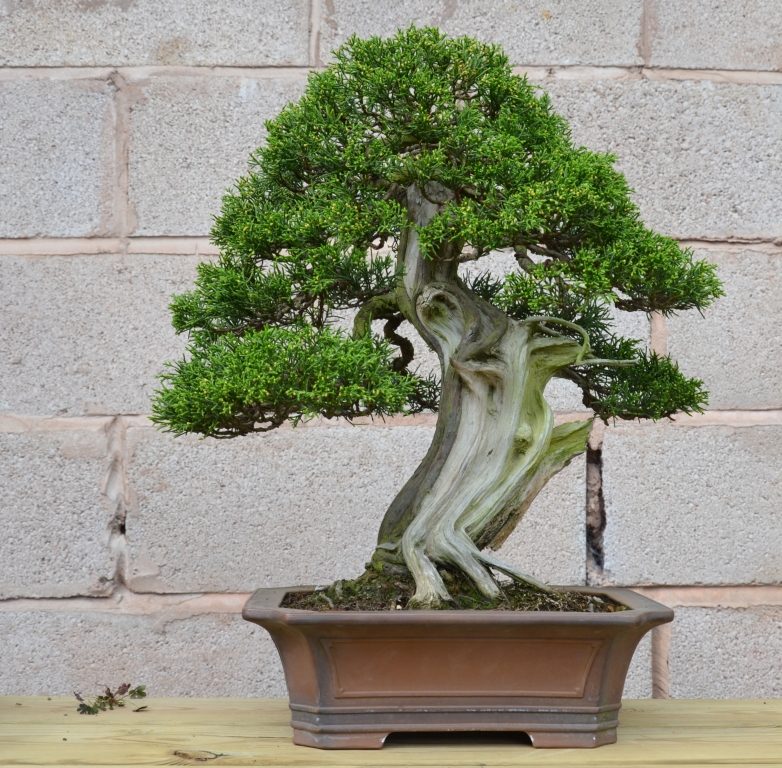
Despite the heat and runny nose I managed to work on some trees this week. Here just putting the finishing touches on the foliage of this Itoigawa Juniper.

But Hay Fever apart I always look forward to July because it is at this time you can clearly see which yamadori are going to survive after collection/purchase last Autumn or this Spring. Because by now the summer days which translate as long photo period plus the associated warmth means that trees are having to perform i.e.grow. And so if they are not up to it, it is at this time that they start to struggle. It usually starts in June here or the end of May if we have had a warm early spring, but it is always evident by July. So trees collected last Autumn or this Spring which looked fabulous in April and which you thought were in the bag are now collapsing in front of you. It is one of the reasons why I will not buy trees that have not had at least one full growing season; although I have been shafted by people I thought were either friends or who I thought had good business ethics selling me trees after having told me the trees had been collected years as you may have read in a previous  blog.

Also July means that conifers imported into the UK from Japan or Korea have just finished their quarantine period (end of June) and are now available to be collected which is always exciting.

Updates on my reserved yamadori material are good, with only a few Scots Pines and one or two Portuguese Oaks Quercus faginea, not pulling through after collection. All the Sabina Junipers are growing well and I am looking forward to receiving them in a few weeks.
Here is a taste of what's coming.


This is a kifu sized Sabina.


 A nice chuhin size Sabina on it's way here soon!
As well as this batch of smaller Sabina's which range from shohin to just over chuhin size, I have been offered some larger well established junipers which are top quality and ready to style now.
Just look at these below.


With my friend stood in the back ground, you can get some idea of the size and scale of these junipers. Again they are fabulous quality, having great movement, natural deadwood, nice healthy foliage with great potential for creating superb bonsai. These will certainly make great bonsai for the future.


And from a different angle. You can see they are all very different from each other, which is something I aspire to when selecting material for styling. I like to have a variety in the forms of the trees so that things are not all the same, which is something I dislike about the mass produced Asian trees. However in their defence, they are being grown to satisfy a certain niche in the hobby. Where as I am looking for trees with individuality!


Here's a close up of one of the group. As you can see this juniper has individuality and in the right hands will make a superb bonsai in the future.
I am really looking forward to receiving these bigger junipers later in the year and I will keep you posted on their arrival here through my blog.


And one more just to wet your appetite!
Again this one is completely different to the one above, again a tree with individuality!
I think I am going to be very busy this autumn styling some of these for myself, but don't panic guys, I can't keep them all, can I ?


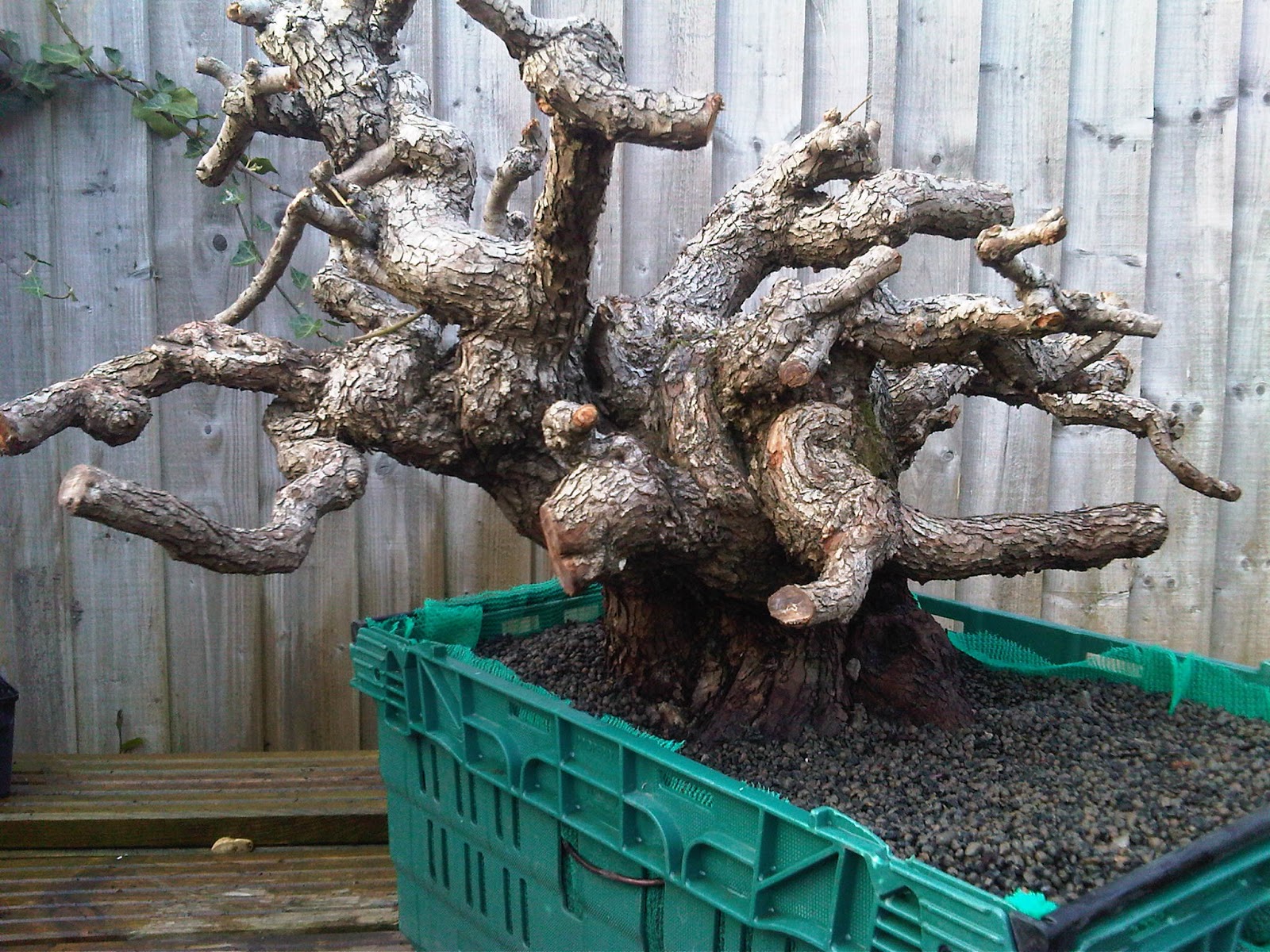
Today has been a great day, and I am not refering to Andy Murray winning the Mens Singles at Wimbledon. I have become the custodian of a new tree 'Medusa', a very special Hawthorn Crataegus monogyna. 
I think this tree has the potential to be a very significant bonsai for the UK in the future and I feel very privileged to own her.

It is possibly the best Hawthorn I have ever seen collected and I feel a real responsibility to ensure she reaches her full potential.
The circumstances under which I have been able to obtain 'Medusa' are sad, however I would like to thank Warren and Simon for giving me the chance to own her and for having the faith that I will bring out the best in her.
I can't thank you guys enough and I won't let you down. Thanks again!

Oh and well done Andy Murray!

Friday, 5 July 2013

Last week.

Last week I managed to catch up with my old buddy Dan Barton and spend the day doing what we used to do best, talking all things bonsai.
Now for those of you who don't know Dan well, he is 74 going on 13.
Need proof? This is Dan watching my demo in Switzerland at Schinznach - Dorf in 2008. Only he could find a new use for raffia. Here's me trying to style a huge Taiwanese Juniper and he's larking about.
So when we meet up it's like going back to my school days in more ways than you can imagine.
However apart from acting like two kids and putting the world to right, we mainly talk bonsai, bonsai and more bonsai. Aesthetics, techniques, philosophy, UK scene etc.
Of course for sensible conversation and great food there is also Cecelia (Ci to everyone) Dan's long suffering wife. So when when I am down Bristol way I get to be with two of my favourite people in the world, and just occasionally (read every time) I come away with a pot or two or three! I was fortunate on this visit that Dan had just emptied the kiln and so I got to see some of his recent ceramic work which is something I have missed out on alot in recent years. I really appreciate good ceramics and especially bonsai and accent (companion plant) pots. Dan and Ci had produced some really special accent pots in this batch and it was nice for me to see some of the new glazes Dan has been working on including a new red and a yellow that are 'in your face' glazes and also to see some of the more creative 'spontaneous' pots that only Dan can produce.
I bought a lovely crackle glaze pot while I was there which I will share with you here. It is for a tree not a companion plant. Stunning!


I also came away with six pieces that I can only describe as ceramic Ji ita. More on those in another post.
Although Dan sold off nearly all of his major trees many years ago now, there is still a nice peaceful atmosphere to the garden. Dan is still taking air layers and growing from cuttings and seeds, but then is that not how it should be. Creating new life, and new trees for others to experience and enjoy in the future long after Dan has gone. This creating of life and a love of life and of people is very much what bonsai is really about, but unfortunately this ideal is little followed or understood by many people. The bending of trees prevails unfortunately.

It was nice to catch up with a few trees that I have known since the first year I started on my bonsai journey.
There is a semi cascade or Han Kengai Japanese Black Pine Pinus thunbergii that was grown from seed by the late David Joyce and which Dan has continued to develop in Davids memory and it is really starting to come into its own now after maybe three decades or more. There is also a lovely Guelder Rose Viburnum opulus from a cutting also started by David that Dan is also continuing to develop. Both of these trees have a special significance for me because David Joyce was a friend of both Dan and myself and when David was really ill battling cancer, Dan and I along with Ci would go to Ledbury to work on Davids trees for him because it upset him to see them not at their best. And I can remember clearly being there one day and although it was not warm, the sun was shining on the back of the house and David sat in a chair on the patio with a big blanket wrapped around him and as we worked on the trees he had this gentle smile on his face. And these two trees that Dan is now the custodian of, bring the memories of that day back to me every time I see them.
Dan also has a raft Mountain Maple Acer palmatum that started life as a small air layer taken off a tree in his garden. The first time I saw it, the trunks were like pencils and I can remember Dan saying to me, "One day this is going to be nice Sunshine". I looked it up and down and walking away dismissively said "I can't see it myself". (That's beginners for you, what a pillock!).
Now it is looking the part, a very natural maple image not bonsaied to death showing a maturity in the trunks and branches. Of course Dan never misses the chance to remind me of the comment I made when I was a beginner. And of course I was reminded again on this visit. I would gladly run off with the tree now but don't tell Dan! So it was great for the two of us to stand in front of the tree now discussing it's merit's, it's progression and what will need to be done in the future for the once little air layer to reach it's potential. That my friends, is what bonsai is all about.

Tuesday, 25 June 2013

BOBB 2013

Well 'The Best of British Bonsai' (BOBB) has been and gone now. Since then much has happened in a short space of time!
But first BOBB.
The Best of British Bonsai 2013 is now history and I guess everyone is looking forward to other Bonsai events on the horizon.
Over the last few days, while taking a break with my family, I have had time to reflect on what has not been an easy BOBB, when compared with the previous two that were held at the Botanical Gardens, Birmingham.
However what this BOBB has shown, is that despite all the doubts in many peoples minds, the will it won't it go ahead whispers, the bad mouthing on the internet through FACEBOOK and various bonsai forums, and the personal puerile emails sent to myself, people can come together to put on a wonderful display of trees for themselves and for others to enjoy. It has also proven that the dedication of some people has no boundaries as many have stepped up to be counted when we have been struggling to put on the event. This coming together and sharing the passion of bonsai and wanting the event to succeed is surely what the spirit of bonsai is all about.
 'Friendship through Bonsai' is the term coined by the late John Naka and through BOBB we have experienced that. The fact that the RHS gave the stand a RHS GOLD Medal is proof enough that every ones efforts were recognised and I thank you all.

A big thank you to Kath and Malcolm Hughes for again putting on a superb show. Who else in the UK has a CV like theirs when it comes to putting on big events.
For Dan Barton, a special thank you for doing the judging at short notice and at a time when your health is not at its best. And thanks for being my 'Buddy'!

At this point I would normally thank Kath's 'Red Army' for all their help stewarding, putting up the displays, answering questions from the public etc. But this year we had Kath's 'Rainbow Army' as everyone sported their own club/society tee shirts. You all did a sterling job yet again.

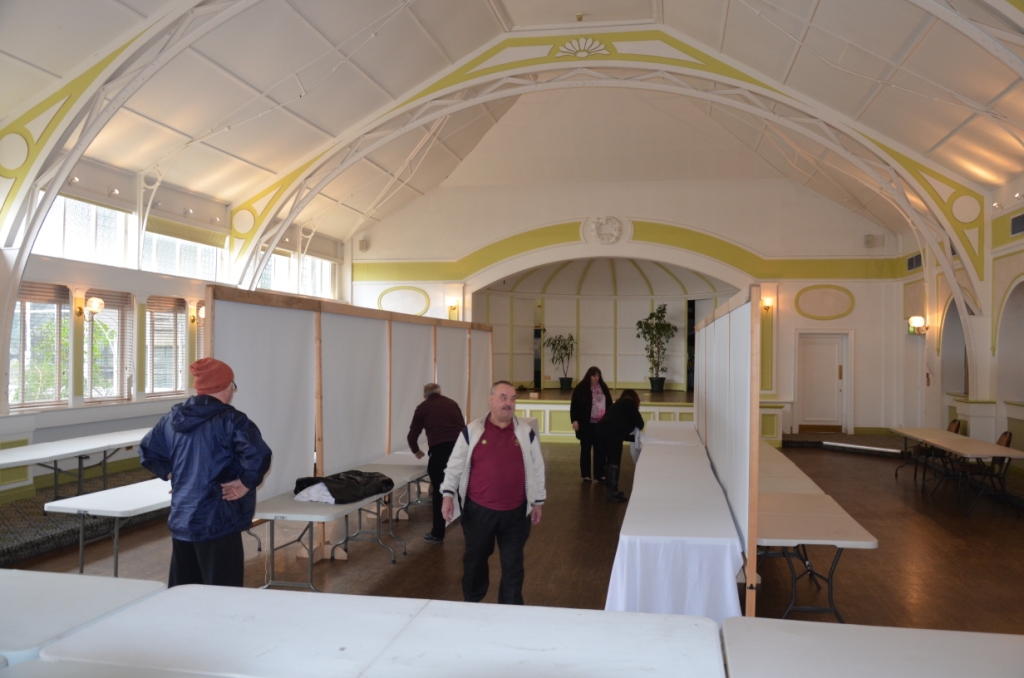
To give you some idea of a little of what was involved this is the hall on set up day.


And as things progressed;


With the screens now in place it is starting to look something like it. The table tops and green hessian were provided by the organisers. The top dressing and screens were provided by ourselves.


As the owners bring the trees to the NEC on the Monday, I can start to set up the exhibition.
This year, as we did not have a photographer recording the trees, it was possible for me to put the trees in their designated places fairly quickly and I must say that things went smoothly.


And we are up and running!
As the doors opened at 9.00am, the crowds flocked in.
This is a view from the demonstration area looking down the first aisle.


A special thanks must go to Mike Sadler for his dedication to watering all the exhibits for the duration of the event. Having someone like Mike on the team to water every ones trees to perfection without ruining the display area was a bonus. I really appreciated the many hours that he spent everyday ensuring every thing was tip top. It is a big responsibility to take on, but one that he did admirably. ( Mike's watering sessions took nearly three and a half hours every morning, with some accent plantings and trees needing more attention again later in the day). Thank you Mike.
Due to the climate controlled conditions in the venue the trees and accent plantings grew well, in fact some accents were very much out of shape having grown so well. Privets were flowering and many deciduous trees really needed pruning to control their profiles, as growth extensions were protruding on maples, Elms etc. and by Sunday some trees were definitely in need of a 'hair cut'.

This year the demonstrators put on a diverse selection of demo's for the bonsai attendees and the public alike. A big thank you to Chrissie Leigh-Walker, Ramon Hammers, Corin Tomlinson, Marcus Watts and Alex Evelyn for entertaining the visitors. And thank you all for giving up your time and for sharing your expertise.


Here Alex Evelyn putting the final touches to his Scots Pine demonstration tree. A nice elegant image was achieved.
On Sunday I must have wasted about three hours going around various stall holders trying to get a cap like the one worn by Alex. But I had to concede defeat as all the ones for sale had the peak on the 'front'!


And last but not least, a big thank you to everyone who provided their bonsai for the exhibition and a special thanks to those who went the extra mile when things got tight!. Without you guys, there would be no BOBB.
 ********************************************************
This year for the winners of the three categories I gave a bronze Ten Pei (Ten Kei).


The owners of the Best Shohin, Chuhin and Large tree each received this bronze Kingfisher on a Bull Rush.
It is a limited edition sculpture of 150.
I hope that after winning these Ten Pei that the owners will be encouraged now to experiment more when displaying their trees and not to simply rely on an accent planting. 


For the 'Best in show' winning tree, I also gave a bronze Ten Pei.


This time a pair of 'Ducks Flying' by the artist Michael Simpson.
Again this is a limited edition piece and therefore collectible. Both bronzes will only appreciate over time.

The reason I chose these two particular bronzes  from the selection I have for sale, was because of the versatility of their size and because they could be reversed when displayed to give a different direction. So although the way you see both the ducks and Kingfisher in these images here is what the artist has deemed as the front. They could be turned to give a different pose and direction which is not often possible with bronze sculptures.


Best Shohin was a Chinese Elm owned by Ian Warhurt from the Wirral.
Best Chuhin was a Zelkova serrata owned by Marcus Watts, and Best Large tree was a Chinese Juniper owned by Des Lloyd.


Chinese Elm from a cutting!
Ian Warhurst.
Best Shohin.


Best Large Tree owned by Des Lloyd.


Zelkova serrata owned by Marcus Watts.
Best Chuhin Bonsai and winner of The Best in Show at Best Of British Bonsai 2013.


Special mention should be made of Chrissie Leigh-Walker's Red Pine Pinus densiflora, which not only received a MERIT AWARD but it also received a BCI AWARD of Excellence.


Here is a proud Chrissie with her Red Pine displaying her two awards, well done Chrissie.


And finally a few trees from the exhibition.


Zuisho White Pine owned by David Jackson which received a Merit Award.


A rather unusual Hinoki Cypress raft owned by Bill Gordon from the Wirral Bonsai Society.
This tree is rather exquisite and no photographs could do it justice.
The first time I saw this tree when I was judging at a Wirral BS show at Gordale Garden Centre I said to Bill that this tree could be superb in the future, I think that Bill thought I was pulling his leg. I critiqued the tree on the day and told Bill how he could start to fine tune the tree. And Bill has done it to the letter so far. It is a tree that is very natural when you are in front of it and I look forward to seeing the evolution of this tree. A new pot may be in order Bill?


A very well known Chamaecyparis lawsoniana 'Boulevard'
owned by Simon Temblett. This is a tree created over many many years and it is a credit to Simon.
It is not an easy species to work with, certainly not for those who have no patience.
But Simon has persevered to produce a nice image that always makes a statement whenever it is exhibited. 


And finally I would like to end with the tale of 'SKIPPY'. A rather unique tree with a very interesting history behind it.
Again it is a tree that I first saw on a visit to the Wirral Club to judge their annual club exhibition. 
At this point please read this in the voice of Simon Bates with the "Our Tune" theme playing on the radio.

'Skippy' is an Acer palmatum var. dissectum 'Inaba Shidare' and is approximately 45 years old.
'Skippy started off life in a Garden Centre and was purchased by it's first owner in 1973 and duly planted in a rockery along side a pond that was being landscaped.
In 1985 the owner decided to do away with the rockery and pond and so 'Skippy' was dug up..............and dumped in a rubbish skip. Hence the name!
At this point the tree was rescued from the skip. It was found to be riddled with canker and so after removing all the deceased branches it was planted in a polystyrene fish box to recover.
Now you might think that is the story, but wait! After all we are talking the Wirral here.
Quote "At this time not being fully aware of the fungus causing the canker and having little knowledge of fungicides; I did suffer from “Athletes Foot” so my logic was that if my condition was a fungus I could use the “Athletes Foot Cream” to protect the tree around the areas of the cut branches, which as you can see worked".

Seriously you could not write it for a comedy sketch could you? 
In 1987 the first styling started in earnest.


2000   At a NBS workshop overseen by Peter Adams, he gave a critique of the maple and he also did a water colour painting, as was usual with Peter,to show how he visualised it would appear in a few years time. At this time 'Skippy' was still in the poly fish box. It was while attending this workshop, that the first proper pot was bought for 'Skippy' from one of the members.
In 2001 'Skippy' is transplanted into its new pot. And life looks rosy.
In 2011 someone special would become 'Skippy's new owner. Sean Dring AKA 'The Baldy scouse git', became the new custodian after helping with the trees development over the past 5 - 6 years.
In 2013 'Skippy' gets its new definitive pot, and like any good fairy tale there was more.
'Skippy' is selected for BEST OF BRITISH BONSAI 2013.

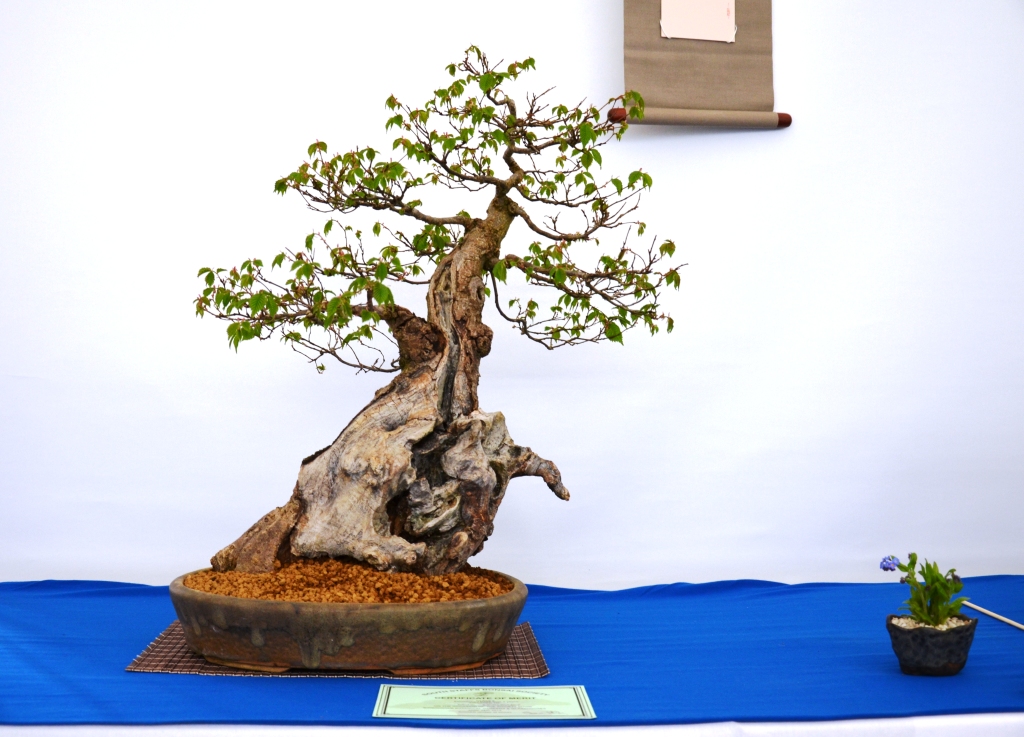
May I present 'SKIPPY'
Acer palmatum dissectum INABE SHIDARE and a proud Sean Dring.


BOBB Photo's courtesy of Kath Hughes.


Monday, 17 June 2013

Recent events part 3

During the 'BEST OF BRITISH BONSAI' event this past week, a guy came up to me and said he had just started reading my blog, and would I talk more about my travelling. By that he meant flights, hotels, airports etc. Well what could I say, I was a little stumped really as I have never thought of myself as Alan Whicker. But personally I find travel, THE most boring part of my bonsai experiences. There is nothing so wasteful as spending hours in airport lounges or sitting next to someone on a long haul flight while they exchange their current flu germs with you. I am a DOER, I like to be doing and not sitting around wasting time. I even begrudge going to bed because there is so much to see and do and so little time and so I like to cram as much into my life as I possibly can.
If only science would move faster so that I could say, "Beam me up Scotty". Bam! I am in the USA, then Bam back home with the family having my tea. If only.
Damn it would revolutionise yamadori collecting. But probably not for the better as it would remove the best parts, the hunting, hiking and trekking before the FIND!
But back to travel. When I go long distances I have my iPod, iPhone and a portable DVD player with me so that I have music, downloads and my favourite films with me to ease the boredom. I love seeing new towns or cities and I love meeting new bonsai people, and if there is one thing that bonsai has done to enrich my life, it is the friends I have made around the world, and the kindness, generosity and support I get.
But I am a home person, I just love being at home with my family. Yes I love helping people to learn  to do bonsai (notice I did not say teach *), I love demonstrating and imparting whatever knowledge I have and at that particular moment in time I am really enjoying myself. But when the gig is over I want to be back home. So that bit in between the finishing my work and being home is the bit I hate.
I once went to the US and they flew me around the world to get there. From leaving home to seeing someone at the airport in the US was 23 almost 24 hours! It could have been a third of that time, and for me its time I could be with my family or at least working on trees. Simply wasted hours.
I am sure many people think that all this travel is glamorous, well its not. Its for young guys with no ties who can go here and there and live out of a suitcase. Also who looks after your trees when you are away weeks on end??

So beam me up Scotty, lets see Sabina Junipers in Spain.


It was a bit of a bumpy landing here among the rocks and boulders. But fortunately there are no Klingons as I am wearing fresh underpants!

Back to reality now, here is the view across a nice patch of Sabina Junipers growing in the mountains. From this photo you would possibly be fooled into thinking that Sabina's have a prostrate growth habit. Well that is not quite true, however they do have a compact form due to the environmental extremes here that they are subjected too and in particular high winds. The rocks and boulders that form a maze of obstacles that they must manoeuvre through to grow out to reach light, helps to form the dramatic trunk and branch lines that make the Sabina Juniper such an incredible species to work with. Offering endless potential for creating unique and wonderful bonsai.

Here is an example of a juniper in situ among some scree and quite large rocks. The contorted and twisted form of the trunk pokes out hinting at the potential that this tree could have. However it is a mistake to get too excited until we have ascertained if this particular juniper is collect able. Some trees are just not viable for collection, but with experience you can have a good idea of what the survival chances are for a tree and whether you should even attempt to remove it from its home. Better to leave it, take a picture and keep the memories than to risk killing something so beautifully created by nature.

Here the spine of a leviathan rises out above the sea of green.
The problem that such incredible material creates for the owner of such trees, is being able to arrange the foliage in such a way as to complement the incredible movement and deadwood that nature has already provided and not to stifle it with technique and formulaic design.
In the US they have an expression ' cookie cutter bonsai'. Well I have always been against what I call bonsai by numbers. You have seen it many times when irrespective of the trunk line or mass, we get the old 'China mans hat' silhouette or triangle of foliage planted on a tree. Now that tree could resemble a ballerina or a sumo wrestler but we get the same blob of a silhouette on both. Creative? No! Easy? Yes!.

This final image shows Sabina's growing over a cliff, not for the faint hearted. But I hope you can get a feeling from these images of the internal and external influences that nature forces upon these trees in their natural habitat. The rocks and boulders, rocky substrate, high winds, freezing temperatures in winter, baking temperatures in the summer, massive fluctuations in seasonal rainfall, ultra violet rays at altitude etc.

So I think that before we collect these trees, step back, evaluate, show respect. It is not your right to collect. So do it responsibly and when the odds favour the tree surviving.

************************************************************

One of the things that has typified this season so far has been the slow start. Many different species have been slow to come into leaf, with bud swell being very drawn out and in some instances non existent until into May.
Also many people have emailed regarding their pines with many experiencing pollen sacks and cones in the place of nice healthy candles. But this is not just something that us Brits have experienced, many bonsai growers in Europe have also experienced similar anomalies.
When I bred raptors professionally there would be times when everyone in Europe and sometimes around the world would have a disastrous breeding season, with everyone experiencing the same issues. And its the same with the start to this years growing season. And the one thing that links us all is the weather/climate. However do not think it only affects our bonsai. It is affecting trees and plants in nature just the same.
On a recent walk in the Wyre Forest where I live and more recently in the Clent Hills, almost every pine tree, both Lodge Pole and Scots, were covered in pollen sacs and cones.
So sometimes it's best not to panic and think what am I doing wrong, because sometimes things are just out of our hands.

Sometimes we are forced to accept what nature throws at us. It is how we get over these obstacles and adapt our husbandry to cope, is invariably what makes us successful.
This image shows Scots Pines on the Clent Hills. It was taken with my iPhone so sorry for the quality, but I just had to capture this image as every tree could be seen to have issues. It was interesting that a lot of deciduous trees and the Larch  (deciduous conifer) were very slow to show any growth and were well behind their normal growth cycle for the time of year.

Nature is by far the most destructive force on the planet as well as being the most incomparable  creator of beauty. And we can learn a lot from it if we only take the time.


* I do not teach people bonsai. I merely help them to learn. They teach themselves.

Recent events - continued!

As I mentioned earlier, two Midlands clubs held their annual shows recently at the Botanical Gardens at Edgebaston, Birmingham.
The second show was held by the Midlands Bonsai Society (MBS) who meet monthly at Moseley Cricket Club. Like the South Staffs group, they are a great bunch of guys. As I am an Honourary Member of MBS I gave a short demo during the day as a means of giving them support.
For the demo I took an Italian Cypress. I chose this tree for two reasons, in the first instance because the material was ideal for a demo over a few hours and in the second, to introduce people to the species, Cupressus sempervirens.
This is the tree before the demo.

 
Nothing too testing here, just a basic first styling to set the structure or skeleton of the tree.
I really hope people will see the potential this species has for bonsai as it has many good qualities for bonsai cultivation.
These include a foliage which tightens and hold form well, a wonderful craggy bark which offers something different to the red polished live veins of junipers with which this species is often confused, and it has branches which hold form after only a short period of being wired.


An hour and a bit later and the tree has had it's first styling and basic shape. And I do mean basic as there is not a lot of foliage to create an image with, we are simply drawing lines in space. The form of the tree becomes more apparent as the foliage masses develop with a proper feeding regime.
Once you have the skeleton, then you can start to put the flesh on the bones. It is more important to get the structure correct, right at the start otherwise you run into problems a few years down the line. Then to make those corrections at that point after years of development means that in fact the tree is now going backwards. When you build a house you need good foundations and when creating bonsai you need correct structuring which very few people talk about.

Unfortunately I did not have my camera with me for the MBS show and so I did not record any of the exhibition to share with you here. Also the image of the Cypress above was taken from my website, as I could not record that at the show either.
Something that did arise from the MBS show, was that they chose to erect the tables and screens for the exhibition across the room (short width), as opposed to down the length of the room like the South Staffs guys did. This afforded more light from outside to shine down the length of each table run, giving better lighting to the whole room which has always been a let down for this venue, even at the first two Best of British Bonsai events, lighting was always an issue.
The MBS guys put on a nice exhibition, certainly the best I have seen them do for many years and this year the disparity between the best trees and the more novice trees should I say, was not so great. The level of members trees has been raised significantly and long may it continue.

Because the Botanical Gardens were open to the public for free this particular weekend and due to the good weather. There were plenty of people passing through the exhibition and many showing real interest.
For the bonsai people who were there, Walsall Studio Ceramics, Dave and Mark Jones were in attendance with a fine selection of pots. Corin Tomlinson from Greenwood Studio's (son of Harry) was also in attendance and he had sales tables with trees and tools for sale.
Thank you to all the MBS guys for making me welcome and Simon for your support.


In between teaching, travelling, doing demo's, hospital trips and the like I have also styled some trees for people as well. Some have been for students who are too busy with work, some for regular clients and some from new clients.


This Juniper here was seriously in need of a makeover. It was one of three trees I was asked to style for a guy in Scotland. I styled two of the trees and did some work on the roots and foliage on the other a Taxus.
Unfortunately I see many trees that have regressed, either through lack of time on the owners part, pure neglect or incorrect technique.
The foliage on this particular juniper had become open and 'leggy' for what ever reason. I have had to address the foliage problem first before styling. This shot was taken just after styling, (it has not been treated with Lime Sulphur here as the owner wanted to do that themselves) Now it needs be pruned properly in the years ahead to get the foliage back to the condition it was about 5 years ago and to maintain the form we expect of this species. By that I mean Itoigawa = Tight Foliage. I hope the owner will keep up with this as it is a very nice tree.
This tree once won the BEST CHUHIN award at the Newstead Awards many years ago but has been allowed to regress since then. I often wonder if this is the fate of many other trees just based on the number of trees that I have sold over the years which just disappear into the ether!

Art in time, for time !

Thursday, 13 June 2013

Recent events !

With both Moms battling cancer, Kathy's and mine, and with a ridiculously busy schedule for the last few months there have been no blog posts. Sorry. Time has been a big problem, to sit down for 5 minutes and write a blog post would be a luxury! Time is not something that I have had much of recently, and when I have, my mind has been filled with other things as you can imagine.
But I think we may have turned the corner on this current path we seem to be on and there are new adventures and I am sure some more tests ahead.

Due to trying to fit so much in and not let anyone down, many days over the last few months have been a blur. And I have to confess to not recording very much, especially to camera. Sometimes I think you can do too much but I have tried to be there for family and still full fill commitments. Or as Bilbo Baggins said in the Lord of the Rings; "“I feel thin, sort of stretched, like butter scraped over too much bread.”I think that sums it up nicely.
Today I should be at BBC GARDENERS WORLD LIVE at the NEC where BOBB 2013 has been staged but you know what, they can manage without me today. The hard part is done, Dan Barton has judged the BOBB Awards, the RHS have judged the stand as a whole as it is their event and the public are now visiting in their thousands. Its time to relax a bit I think.
***********************************

In the last couple of months I have been at the annual shows of two Midland Bonsai Society's.
The Midland and the South Staffs BS. Both clubs held their shows at Birmingham Botanical Gardens as they both have a long affiliation with the place.  

The South Staffs Bonsai Society (SSBS) held their show in April, earlier in the year than is usual for them.
For my troubles, I was judging their show as I did in 2012.
Although only judging, I arrived early on the Sunday morning to see the set up.
Unfortunately, all the members were still outside on the car park waiting to get in as the building had not been opened early. Just as I was thinking I could have had that extra cuppa and slice of toast at home the doors opened.
Despite the fact that entry to the botanical gardens had been held up, things started to come together as many hands make light work.


The back drops used were designed by Dan Barton and work on a roller blind principal. I believe the originals were made by Dan's son Daniel who is just amazing with anything wood.


As things progress, you can feel anticipation building as people prepare to set up their trees.


These very same back drops would be used at BOBB in June.


Here some of the members are bringing in the first of the trees for setting up.


One of the club members Dick Turner was on hand with a selection of his bonsai wire dispensers and stands for sale. And many trees in the show were on Dicks stands.


 Here is a nice Larix. Unfortunately no back drops were used behind this run of trees and so photographs don't do the trees justice.
A nice Deshojo Maple that shows promise for the future.
As with most club exhibitions the standard of trees in any one show is varied. It is rare to see all the trees of a similar standard. And there is usually a big gap between the best trees and the lowest trees.

As a judge at one of these shows, apart from the obvious, actually judging the trees. I try to encourage those with the trees at the lower end and where possible I like to critique the exhibition. This way people can see why trees have succeeded, what needs to be done to develop trees for the future plus they get an insight in to actually why certain trees were chosen that day.


Some trees were exhibited prematurely, but sometimes this is encouraged at club level as there are 'Trees in training' classes. However sometimes there are trees that should be in the 'In Training' class that find themselves in other classes. Unfortunately if I am honest, some of the aspects of UK bonsai club culture stifle the development of the level of bonsai here. Tackling the problem though is not easy as it has been this way from the 60's and many people do not like change or to be told they have been doing it wrong for so long.
My pet gripe is the BEST IN SHOW vs the BEST IN CLASS. Now this is a UK thing which makes me cringe. A juniper might win BEST CONIFER. But a White Pine may win BEST IN SHOW. Surely if the White Pine is BEST IN SHOW, by default it has to be the BEST conifer. But as it was once pointed out to me, 'We can't have a tree winning two prizes'. No wonder we are being left behind by the Europeans when we have such archaic rules at grass root level.


This tree on the right here, belongs to a guy I know very well so I hope he will not mind me repeating here what I said on the day.
The tree has great potential. It has a really interesting trunk, interesting deadwood areas with potential, and dramatic taper. However the maturity of the branch structure is a long way off. For me this is great material, but it is not ready for exhibition just yet.


Here are two of the higher level trees in the exhibition. They are both Juniperus chinensis var. 'Itoigawa'. Originally supplied by myself, they have super potential, BUT!
Even though these are two of the better trees, the owner (same owner) needs to get to grips with the foliage. So they show pleasing images (not my design) but they need to be refined more, to take them to another level. I do not want to critique the aesthetics of the design here but merely to point out the aspects of refinement or attention to detail.
What do you think?

For me it can be a little frustrating, because I know the potential of both of these trees.
Certainly if the owner went the extra mile, they could go to the Noelander's Trophy in Belgium. Maybe now they will, fingers crossed.
Of course I have to take into account the skill level of the owner and their level of understanding of what is A GOOD BONSAI. How much time the owner has to spend on his trees, how much they can spend on their hobby etc etc. And many people of course are happy with their trees as they are, they do not have aspirations to have trees that can be exhibited at a high level. In fact many people in the UK never show their trees at even club level and do not like to have their trees "competing" or criticised as I am doing here.
And that's fine, It is not my place, whatever my own feelings are, to say to someone they must show their tree or to tell them they are not allowing their tree to reach its potential. After all, we all do bonsai for different reasons. But one thing we share is that we do bonsai for the pleasure it brings us and we should never lose sight of that.

However as a bonsai educator I feel the need where ever I can to try to open people eyes to what bonsai can be.
John Naka once said "you can't make a chicken salad from chicken shit" or words to that effect. So Silk purses and sows ears come to mind. However in many cases, like these two junipers here, we have starting off with great material which is glaringly obvious. But as good as they are, they have more to give and only by getting more people to see and to understand this, can we continue to raise the standards in British bonsai or in fact bonsai anywhere.

Bonsai, the art of seeing beyond today!

Wednesday, 24 April 2013

Benefits of the Sun


In only about a week the benefits of that glowing ball of fire in the sky we call the Sun can be seen all around us.
The birds are singing, insects are emerging, flowers are pushing through and buds on trees are opening. Just look at these;


Japanese Katsura Tree
Cercidiphylum japonicum


Flowering Currant Bush
Ribes sanguineum


Winter Hazel
Corylopsis spicata


This morning I took a look at one one of the Mugo Pines that is receiving the poly treatment, to see if there were any signs of root activity on this particular tree.
In the following photo, you can see new roots around 3 inches long (7.5 cms) emerging from the trunk where I have teased the substrate away. This Mugo Pine is one that arrived having no roots earlier this year which I mentioned in my post "My last post for a few days".

Here is how it arrived (image right).


As you can see great care had been taken to ensure the tree had a good root ball to sustain it after collection. NOT!
This tree had just been ripped off the mountain 
side.


And here are the new roots (below) indicating that this tree may now be on the right path. There is still a long way to go just yet, as these may be being generated by residual energy in the tree. However one thing in my favour, is that from my experiences with working with Mugo Pine over many years, is that I know it is the easiest pine to air layer or make roots as a raft' of all the pines readily available to me i.e. from Europe, UK and Japan. So from this I know they put out root readily and hopefully this may be the species specific attribute of this tree that saves it.

Image left; 
Only small beginning's I know, but it is a start.
However it is important to not get too carried away at this point because the residual energy in trees can be quite amazing. I have a lot of experience with Mugo Pine and they can do things that are unreal!.
As an example I have removed a major branch on a Mugo Pine during a One to One workshop held here in September one year. The branch was put on my compost pile along with other plant cuttings. In March the following year, when I went to add some more trimmings to the pile, I noticed the buds on the amputated branch extending. Now that is residual energy.
It also goes some way to explain how unscrupulous collectors can collect a Mugo Pine, and give the potential customer the sales talk it was collected threes years ago. When in fact it has not even been collected a year. The problem is, the tree looks healthy and if you are not experienced you are not to know!  
I think I can confidently say that I have learned so much from working with ancient yamadori than any other aspect of bonsai, although I continue to learn in all areas and it is this constant learning that fires my interest. Working with regular trees, by that I mean 20 year old imported White Pines or trees collected in forestry plantations etc can only prepare you so much for working with ancient collected trees. At the end of the day all the theory in the world can't beat hands on experience. And it is amazing how much information in print is actually wrong. This is possibly due to people generalising when imparting information, a blanket statement covers all idea. E.G. pines retain needles for three years. Some species for 5. From that  you know they have never studied Mugo Pines centuries old.
In the days when I bred and lectured on breeding birds of prey, artificial incubation and artificial insemination, similar things occurred. Over night experts would make sweeping statements on various topics immediately labelling everything similar. If they succeeded at something once, they thought they had it in the bag and if they couldn't do something then it couldn't be done.
However my way was if I have done something and been successful, then I needed to do it again and again to prove it to myself before broadcasting it to the world. And likewise if I failed to do something I would not say this or that can't be done. I would 'say as yet I have not been successful at this'. And I would persevere.
Something like this happened when I introduced Taiwan Junipers to the UK. Nobody could maintain the adult foliage on them which looks just like chinensis foliage. People would treat them in ways not suitable to that species and so they would revert to juvenile foliage rapidly. Because of this, many people in possession of Taiwan Junipers could be seen on various 'tinterweb' forums extolling the virtues of the deadwood and decrying the quality of the foliage. Many well known names have been party to this declaring that they will have to graft their junipers with Itoigawa instead. Well they grew well in Taiwan and for me in the UK, so why couldn't these guys just say ' do you know what, I really struggle with those Taiwan Junipers'. But of course it saves face to say they cant be grown in Europe.
If I can impart one piece of advice today it would be try to learn about the characteristic's or idiosyncrasy's of the species you keep. By that I mean Itoigawa Juniper, Sabina, Taiwan Juniper, Blaaws Juniper look similar. There are some  characteristic's which they share and where they are similar. But there are some characteristic's that are species specific.
Likewise Mugo, Scots, White Pine, Black Pine, Red Pine etc are all pines and therefore some characteristics they share or are very similar and some characteristic's are species specific. And remember, a 25 year old tree is not a 525 year old tree.

On the subject of ancient trees here are some images of some old Scots Pines I have coming. ENJOY!


Fabulous bark quality.


Nice powerful and compact tree with great bark quality.


Interesting movement!


And finally this Sabina Juniper.

This one is a little different from many of the other Sabina Junipers I have sourced as there is not at first glance any obvious movement or lots of natural deadwood. 


It is the power and compactness of this tree that interests me. It is different!.
In this close up you can see that actually there is movement and I think this will be something a bit different when it is styled.
I wonder what surprises are hidden away waiting to be exposed.